


You’re reading How to Live—an inquiry into the psychological forces that shape us, and how to stop being run by them.
Through deep research, personal storytelling, and hard-won insight, I challenge the myth of normalcy and offer new ways to face old struggles.
This work is reader-supported. If it speaks to you, consider a paid subscription for deeper insight, off-the-record writing, and seasonal in-person gatherings.
You can also donate any amount.
Creative Inputs: Artists, Ideas, and One Song on Repeat
Hello from Malta!
Things here aren’t going so well—housing issues, but I promise I’ll fill you in another time. I’m feeling pretty miserable and searching for anything to lift my spirits.
For me, that usually means discovering things that fire up my neurons.
Friends, on that front, I’ve succeeded. Today, I’m sharing the best things I’ve stumbled upon, introducing you to someone who always gets me through.
Stumbled upons
A book was on the counter at my friend Jen's and Adam’s house. The cover appealed to me, but it was padded, which I took to mean it was for kids, so I left it closed.
The next time I was over, the book was still on the counter, and Jen mentioned it—she’d discovered the artist at PS 1, where his work was being exhibited.

It wasn’t a book for kids. (Assumptions, always steering me away from what I need.)
I opened it and wandered slowly across the pages. I found it sad, poignant, and funny—my three favorite things.
The book is called Things Felt But Not Quite Expressed, and it’s by artist Sohrab Hura.


The Offset Bookshop is a curated collection of independent publishing projects focusing on South Asian artists. I find their books so special.


Figures
Peter Schmidt

Peter Schmidt
Jen and Adam’s friend Dawn was also over, and she mentioned Oblique Strategy Cards. I’d never heard of these, and when I got home, I dove down into every possible rabbit hole and discovered not only the cards, but who and what led to their existence.
Enter Peter Schmidt, a Berlin-born British artist, painter, theoretician of color and composition, pioneering multimedia exhibitor, and an influential teacher at Watford College of Art,* and his “Thoughts behind the Thoughts.”
(* Taken directly from Wikipedia)
When stuck, or struck with an incapacitating stress, Peter Schmidt was bumped out of the flow of his work, and found it hard to return. This is a familiar conundrum to most artists, and we all have workarounds.
This is why I don’t take lunches with anyone during the week; it’s too disruptive to my work.

Some of Peter Schmidt’s early Artwork
Peter Schmidt began writing down sentences that helped him return to the state of flow. He called his cards “Thoughts Behind the Thoughts” and printed 55 sentences on letterpress to create a box of cards.
When he met the musician and visual artist Brian Eno, both discovered they had this in common, but Eno called his handwritten axioms “Oblique Strategies.”
Here’s a peek at Schmidt and Eno’s early Oblique Strategies…
Peter Schmidt’s first box of Thoughts Behind the Thoughts…

Peter Schmidt’s box of Thoughts Behind the Thoughts cards.
Eno’s first Oblique Strategy viewer and cards…

Brian Eno’s early Oblique Strategy Sentence Viewer

Brian Eno’s handwritten Oblique Strategy Cards
In 1974, the two decided to join forces, merging their cards into one deck and releasing them to the public.
The cards were an instant hit, selling out three limited-edition printings. But in early 1980, just as their influence was growing, Schmidt died suddenly of a heart attack. With no new editions in production, the decks became rare collectors’ items, their prices climbing over the years.
Oblique Strategies evolved from me being in a number of working situations when the panic of the situation—particularly in studios—tended to make me quickly forget that there were other ways of working and that there were tangential ways of attacking problems that were in many senses more interesting than the direct head-on approach.
In 1996, software pioneer Peter Norton convinced Eno to collaborate on a fourth edition, not for sale but as Christmas gifts for his friends. Some copies have since surfaced at auctions but were never meant for the public.
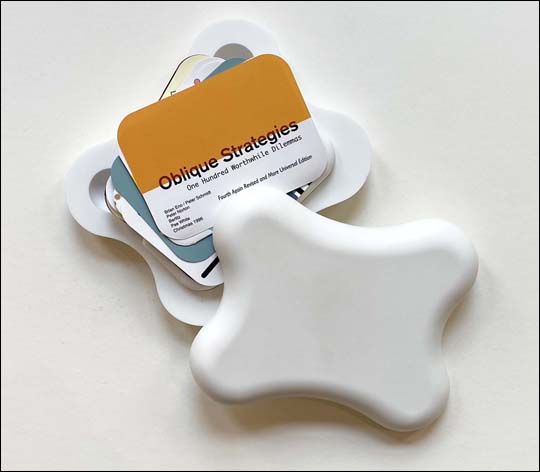
Eno reflected on this revival and his creative process in A Year with Swollen Appendices. Interest in the cards never faded, and in 2001, Eno released yet another edition.

Each version has had slight changes—some cards added, some removed—keeping the deck constantly evolving. In 2013, a limited run of 500 decks was released in a deep burgundy box instead of the usual black.
For those obsessed with Oblique Strategies, musician and educator Gregory Alan Taylor has painstakingly documented the full history on a website widely considered the definitive source, including every card ever printed.

These are David Bowie’s well-worn cards.

David Bowie’s Oblique Strategy Cards

Moral of the Story:
Go to your friend’s house.
Song I’m revisiting
I first came across Katell Keineg in the early 90s when I lived above Sin-é In the East Village. I would listen to Jeff Buckley, Mark Geary, and Katell Keineg, musicians who soon became my pals.
I loved (and love) her voice. It’s atypical: gravelly, strong and occasionally faltering, worn, wise and original. Her voice has everything I like in a person.
She’s still one of my favorite musicians. I own every album, know each song, and when I’m feeling contemplative, it’s raining a forever rain, or democracy is quickly falling, this song is the one I play.
Nathalie Merchant covered it and gave it some legs, but I’ll always be true to the writer of the original song.
Please don’t give up before the first chorus.
Until next week, I will remain…

Amanda
P.S. Thank you for reading! This newsletter is my passion and livelihood; it thrives because of readers like you. If you've found solace, wisdom or insight here, please consider upgrading, and if you think a friend or family member could benefit, please feel free to share. Every bit helps, and I’m deeply grateful for your support. 💙
 Upgrade
 Share
Share
Quick note: Nope, I’m not a therapist—just someone who spent 25 years with undiagnosed panic disorder and 23 years in therapy. How to Live distills what I’ve learned through lived experience, therapy, and obsessive research—so you can skip the unnecessary suffering and better understand yourself.
Some links are affiliate links, meaning I earn a small commission at no extra cost to you. Every bit goes straight back into supporting this newsletter. Thank you!