

You’re reading How to Live, a weekly examination of the forces shaping your thoughts, choices, and patterns you can’t escape. Most of what drives us operates below awareness; this newsletter names it.
Paid subscribers make this work possible. They also get what free readers don’t: psychological insight that doesn’t just explain your life, it makes it conscious, like something you already knew but couldn’t name. Plus four years of archives, twice-yearly essays drawn from what readers are thinking about, and a monthly vote on the next topic. $6/month or $67/year
Buckminster Fuller and the Sixty-Six-Year Experiment to Document His Existence
I live on Earth at present, and I don’t know what I am. I know that I am not a category. I am not a thing — a noun. I seem to be a verb, an evolutionary process – an integral function of the universe.
Two weeks ago, I wrote about the prompt Linda Rosenkrantz gave her friend Peter Hujar: “Keep track of everything you do in a day. From the moment you open your eyes to the moment you close them.”
She wanted to know what creative people did all day. How did they spend their time? She didn’t think they did nothing; she felt she did nothing.
She had to know: What did her artist friends do all day? I wanted to know also, so I took the challenge. I tracked a full day and after sharing it, many of you followed suit.
Those who kept track know it felt a little exposing, a little silly, but mostly harmless. Besides, it ended at midnight.
But what if you kept going? What if you decided to keep track, not just of your day, but of your entire existence, every day, until you died?
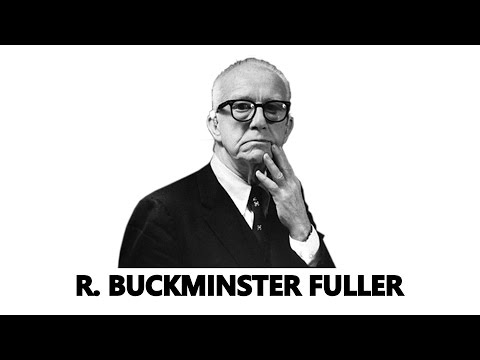
The famous generalist, Buckminster Fuller did just that. The architect, systems theorist, inventor, philosopher, self-taught mathematician, futurist, the man who patented the geodesic dome, served as the second World President of MENSA and popularized the term "Spaceship Earth," started keeping track of everything he did, said, read, thought, and received and kept adding to the record every day after that for the rest of his life, until he died in 1983.
One would assume that Fuller was driven by deep curiosity. Invested in knowing the depth of his feelings and emotions, attentive to the hourly contours of his interior life. But, that wasn’t true. Not at all.
The project began because of an epiphany that told him his life didn’t belong to him—it belonged to the universe. His thoughts, he believed, were the truth — not his feelings.
Buckminster Fuller was born July 12, 1895, in Milton, Massachusetts, to a family that expected him to graduate from Harvard and move into a respectable profession, but Harvard expelled him twice (he preferred “fired.”) The first time for spending his tuition money on a touring dance troupe he'd taken a liking to, the second for simply not showing up anymore. He left with no degree, married Anne Hewlett in 1917, and joined the Navy, where he spent the war inventing a winch to pull downed pilots out of freezing water.
Their daughter Alexandra was born the following year. In 1922, just before her fourth birthday, she died of complications from spinal meningitis and polio. Fuller became convinced the cold, damp apartment they lived in had caused it. He and his father-in-law started a company built around that conviction: the Stockade Building System, lightweight, weatherproof housing panels, as though the right invention could reach backward and undo the thing that had already happened.
But in 1927, the company collapsed and Fuller was pushed out of his own firm, with no savings, and a second daughter only months old. He had a nightly habit of walking the streets of Chicago. The dark, quiet, streets offered an outlet for his restlessly creative mind.
On one of those walks, in the autumn of 1927, he stopped at the edge of Lake Michigan. He calculated how long it would take to for him to grow hypothermic and drown. His life insurance would pay out, and his wife and daughters would be provided for.
Standing on that shore at age 32, feeling like an absolute failure, suicide felt like the only responsible decision.
But as he stood there, on the precipice of ending his life, he felt briefly suspended above the ground, and he heard a voice in his head that said:
“From now on you need never await temporal attestation to your thought. You think the truth. You do not have the right to eliminate yourself. You do not belong to you. You belong to the Universe. Your significance will remain forever obscure to you, but you may assume that you are fulfilling your role if you apply yourself to converting your experiences to the highest advantage of others.”
The conviction he felt from that thought marked the beginning of a life dedicated to replicating this sense of certainty by documenting the certainty of his existence.
He went home and told Anne that he was done making decisions based on how he felt. He called it committing egocide. Not suicide, the death of the body. Egocide, the death of the part of him that ran on feeling.
He said that he had to think, and would not utter a word until he knew what he truly thought. For two full years (or so he claimed) Fuller was silent. He filled five thousand pages with notes, in pursuit of the secret to success for the entire human race.
Fuller decided to make his life an experiment “to find what a single individual can contribute to changing the world and benefiting all humanity.”

Never work for a living again Instead, he would dedicate himself to solving real problems.
Only act on what he called ‘dynamic integrity’ do what feels “cosmically right,” even if it looks foolish.
Only trust his own thinking Don’t let anyone else think for you. Think only for yourself.
In a 1962 lecture at the University of Oregon, he said: “[What would happen] if somebody kept a very accurate record of a human being, going through the era from the Gay '90s, from a very different kind of world through the turn of the century. I decided to make myself a good case history of such a human being.”
He’d kept scrapbooks since 1917, but after this transformative experience at the lake, he committed to meticulously track his daily life. He resolved to treat himself as an objective case history for the benefit of future generations.
From that moment until his death in 1983, Fuller logged nearly everything: incoming and outgoing letters, bills, receipts, sketches, blueprints, newspaper clippings, and, starting in the 1960s, audio recordings and film of his own lectures. Like any extensive archive, you can watch the century happening to the man who was recording it.
He called it the Dymaxion Chronofile (a neologistic concoction made from dynamic, maximum and ion) What survives of it lives in Palo Alto, in the special collections at Stanford. Something like 140,000 documents, spanning more than 1,400 linear feet.
Fuller externalized his life so thoroughly that he barely had to report on his internal one at all.
Paid subscribers make this work possible. They also get what free readers don’t: psychological insight that doesn’t just explain your life, it makes it conscious, like something you already knew but couldn’t name.
The archive is cross-referenced alphabetically using close to 13,500 index cards, so that any day of his life could be pulled up against every other day connected to it, by person, by subject, by object. A personal Akashic records.
Open one of those volumes and you might find a letter from Einstein filed next to a dry cleaning receipt. A note from the sculptor Isamu Noguchi beside a grocery bill. Nothing in the system tells you which one mattered more, because Fuller built it so that nothing would.
In the book, You Belong to the Universe, the experimental philosopher Jonathon Keats (full-disclosure, Keats is a friend of mine) argues that Fuller's own version of this story, the two years of near-total silence, the five thousand pages of notes, doesn't fully match the documentary record Fuller left behind.

Which is not surprising, given that much of Fuller’s life was an experiment in self-mythology.
All this brings us to a new prompt.
A few months ago, while I was walking Busy, I decided to record every thought I had. The idea was to see how many of my thoughts are recycled, and how many are original (I think you can guess the answer). If you’ve been reading this newsletter for awhile, you might have noticed my preoccupation with the paradoxical nature of being a person — we are all sharing the experience of being human, yet no one can ever feel or truly know any one else’s experience of being human. I don’t know if how your mind occupies itself is more or less productive than the way mine does.
I wanted to know how people spent their mind’s time.
So, I’m going to ask you, and I’ll do it myself (again), to keep track of every thought or snippet of a thought you have in a day. You don’t have to write the entire thought out, you can contain it. Like:
“Need new bathing suit. Should shower. Back pain. More Aleve or will it hurt my stomach?”
There is a part two to this, but you’ll have to wait until next week.
THE PROMPT:
For one day, write down or record every thought you have. The thing you forgot to do, the memory of laughing with your best friend during a quaker meeting in tenth grade, the thought about the thought you just had.
Do not keep track of your feelings and emotions. Thoughts only.
If you want to share them with me, I’d love it. If I can share them without your name attached, I’d also love that.
If this newsletter helps you connect to yourself and others, if you feel seen, engaged, understood or less alone, please consider a contribution today.
Until next week, I will remain…

Amanda
Need to change your subscription? Scroll down to the bottom a and click on “manage preferences.”
Free readers get the ideas. Paid subscribers go underneath the hood: essays that examine the forces shaping behavior, the patterns we repeat without realizing, and the desires we inherit rather than choose.
 Upgrade
 Share
Share
Some links are affiliate links; every bit goes straight back into supporting this newsletter.